02031613720
Learn how ISO 9001 certification helps small businesses improve quality, build trust, and manage risks with simple systems that support growth.
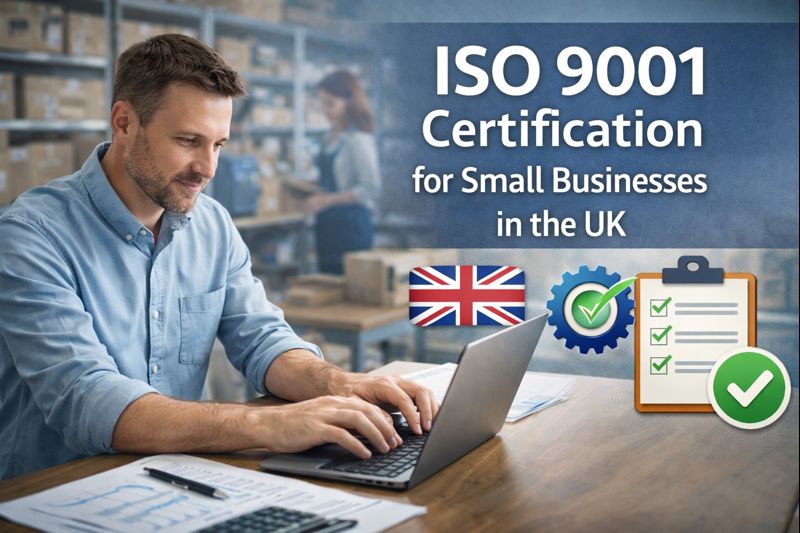
Small businesses often believe that ISO certification is only for large organisations with complex systems and large budgets. In reality, many international standards are designed to work just as well for smaller organisations, provided they are applied in a practical and proportionate way.
ISO 9001 certification is one of the most widely used standards by small businesses across many industries. It helps organisations improve consistency, reduce mistakes, and build confidence with customers and partners. This guide explains how ISO 9001 works for small businesses, why it matters, and how it can be applied without unnecessary complexity.
ISO 9001 is an international standard that focuses on quality management. It helps organisations control how work is done, meet customer expectations, and improve over time.
For small businesses, ISO 9001 is not about creating heavy paperwork or rigid rules. It is about understanding daily activities, setting clear responsibilities, and making sure work is done in a consistent and reliable way. When applied correctly, the system supports growth rather than slowing it down.
Consider a small service company with fewer than ten employees. Customers are generally satisfied, but complaints are handled informally, and knowledge is shared verbally. When someone is absent, mistakes are more likely to happen.
By applying ISO 9001, the business defines how enquiries are handled, how work is checked, and how issues are recorded. Nothing becomes complicated, but everything becomes clearer. Over time, fewer errors occur, customer confidence improves, and staff feel more secure in their roles.
This example reflects the real purpose of ISO 9001 for small organisations.
Small businesses often face strong competition and limited resources. ISO 9001 helps by providing structure and credibility without requiring large teams or complex systems.
Many small organisations use ISO 9001 to show that they take quality seriously. Others use it to reduce rework, improve communication, or prepare for growth. The standard is flexible enough to support different goals, as long as it reflects how the business actually operates.
Yes. ISO 9001 can be applied to organisations of any size. The standard does not require departments, formal job titles, or complex reporting systems.
For very small organisations, the quality management system may be simple, with fewer documents and combined roles. What matters is clarity, not scale. Auditors assess whether the system fits the organisation, not whether it looks impressive on paper.
Many small businesses hesitate because they believe ISO 9001 will create unnecessary bureaucracy. This concern usually comes from poorly designed systems, not from the standard itself.
ISO 9001 allows organisations to decide how much documentation is needed. If a process is clear and low risk, it does not need excessive controls. The goal is effectiveness, not formality.
ISO 9001 helps small businesses manage daily work more effectively by encouraging consistency and accountability. When processes are clear, staff know what is expected, and work becomes easier to manage.
The standard also encourages regular review. This helps identify small issues before they become serious problems. Over time, this leads to better decision-making and stronger performance.
ISO 9001 is often used as a foundation for other standards as a business grows.
For example, environmental responsibilities may later be addressed through ISO 14001, while health and safety risks can be managed through ISO 45001.
Small technology or service-based organisations may also consider ISO 27001 as data handling becomes more important. Starting with ISO 9001 makes it easier to integrate these systems later.
Audits for small businesses are usually shorter and more focused than those for larger organisations. Auditors look at how work is actually done, speak directly with staff, and review simple records.
The audit process is not designed to be intimidating. It is a structured review that checks whether the system works and whether improvements are being made. For more detail you can read this: Common ISO 9001 Audit Non-Conformities & How to Avoid Them
One common mistake is copying systems designed for large organisations. This often leads to unnecessary complexity and confusion.
Another mistake is treating ISO 9001 as a one-time task rather than an ongoing system. Certification is important, but the real value comes from maintaining and improving the system over time.
As small businesses grow, informal processes often stop working. ISO 9001 provides a framework that supports expansion without losing control.
Clear processes make it easier to train new staff, manage suppliers, and maintain quality as workload increases. This reduces stress and supports long-term stability.
ISO 9001 certification is widely recognised and understood. For small businesses, this recognition can help build trust with customers, partners, and regulators.
The certification shows that the organisation has systems in place to manage quality consistently. This can be especially important when entering new markets or working with larger clients.
ISO 9001 focuses on management systems rather than products. It is different from marks such as CE Mark, which relate to product compliance.
Some industries may also use schemes such as Halal Certification, depending on their activities. ISO 9001 complements these requirements by improving overall management control.
ISO 9001 certification is not only for large organisations. When applied correctly, it is a practical and valuable tool for small businesses.
By focusing on clear processes, consistent delivery, and continual improvement, ISO 9001 helps small organisations work more effectively, build trust, and prepare for the future. The key is keeping the system simple, relevant, and aligned with real business needs.
Yes. ISO 9001 is designed to work for organisations of all sizes, including very small businesses.
No. The standard only requires documentation where it adds value. Small businesses often use simple and practical records.
Costs vary, but systems for small businesses are usually simpler and take less time to implement and audit.
Yes. In many small organisations, one person manages the system alongside other responsibilities.
Yes. ISO 9001 supports growth by improving consistency, reducing errors, and making processes easier to scale.
 1
1
Typically replies within 30 minutes