02031613720
ISO certification is not legally required in the UK, but often needed for contracts. Learn when ISO is mandatory and what UK businesses must know.
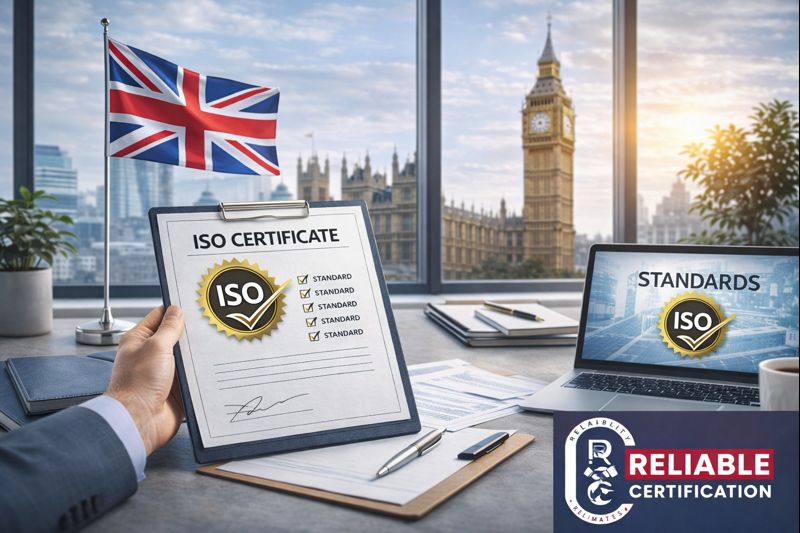
For many UK business owners, ISO certification sounds important but also confusing. A common question is whether it is legally required or simply recommended. The short answer is that ISO certification is usually not mandatory in the UK, but in many situations it becomes essential in practice.
This guide explains the difference clearly, in simple English, so you can understand what applies to your business and when ISO certification really matters.
ISO certification is not legally mandatory for most UK businesses.
However, it is often required for contracts, tenders, and supply chains, which makes it commercially essential for many organisations.
ISO standards are developed by the International Organization for Standardization, an independent international organisation that publishes best-practice standards for how businesses manage quality, safety, environmental impact, and information security.
Common examples include:
ISO certification means your organisation has been independently audited and confirmed to meet the requirements of a specific standard.
Important note: ISO itself does not issue certificates. Certification is carried out by approved certification bodies.
No UK law directly requires businesses to hold ISO certification.
You can legally operate a business in the UK without being ISO certified, provided you meet all relevant laws and regulations.
That said, the legal position is only part of the picture.
ISO certification is usually not required if:
In these cases, ISO certification is optional and often used as a business improvement tool, not a requirement.
Although ISO certification is not required by law, many businesses find it becomes effectively mandatory due to commercial or contractual conditions.
Many public sector tenders require suppliers to hold ISO certification—most commonly:
These requirements are common in:
If ISO certification is listed as a tender requirement, you cannot progress without it.
In sectors such as construction, engineering, manufacturing, and logistics, ISO certification is often expected as standard.
For example:
Main contractors and clients frequently require ISO certification before allowing suppliers to work on projects.
Many large organisations require their suppliers to be ISO certified to:
If your customers are ISO certified, they may expect the same level of control and assurance from you.
It is important to understand that ISO certification does not replace UK law.
UK regulations particularly health and safety law—are enforced by bodies such as the Health and Safety Executive. These laws apply whether you are ISO certified or not.
ISO certification helps you:
In simple terms, UK law tells you what you must do; ISO standards help you prove you are doing it properly.
In the UK, credible ISO certification depends on accreditation.
The UK Accreditation Service (UKAS) is the only government-recognised body that accredits certification bodies in the UK.
Why UKAS accreditation matters:
If ISO certification is required for your business, UKAS-accredited certification is usually expected.
From a legal perspective, no.
From a commercial perspective, sometimes yes.
Many UK SMEs choose ISO certification to:
For growing businesses, ISO certification is often a strategic decision, not a legal obligation.
If ISO certification is not required for your work, there are usually no consequences.
However, if ISO certification is expected:
This is why ISO certification is often described as commercially mandatory rather than legally mandatory.
For more details on this question, you can read this blog: Why Your Business Needs ISO Certification?
The most commonly requested ISO standards include:
The exact requirement depends on your industry, customers, and contract type.
Ask yourself:
If you answer “yes” to any of these, ISO certification may not be legally required but it is likely important for growth and credibility.
ISO certification is not compulsory under UK law, but for many businesses it is essential for winning work, meeting client expectations, and demonstrating professionalism.
Understanding when ISO certification is required and when it is simply beneficial helps you make informed decisions without unnecessary pressure
 1
1
Typically replies within 30 minutes