02031613720
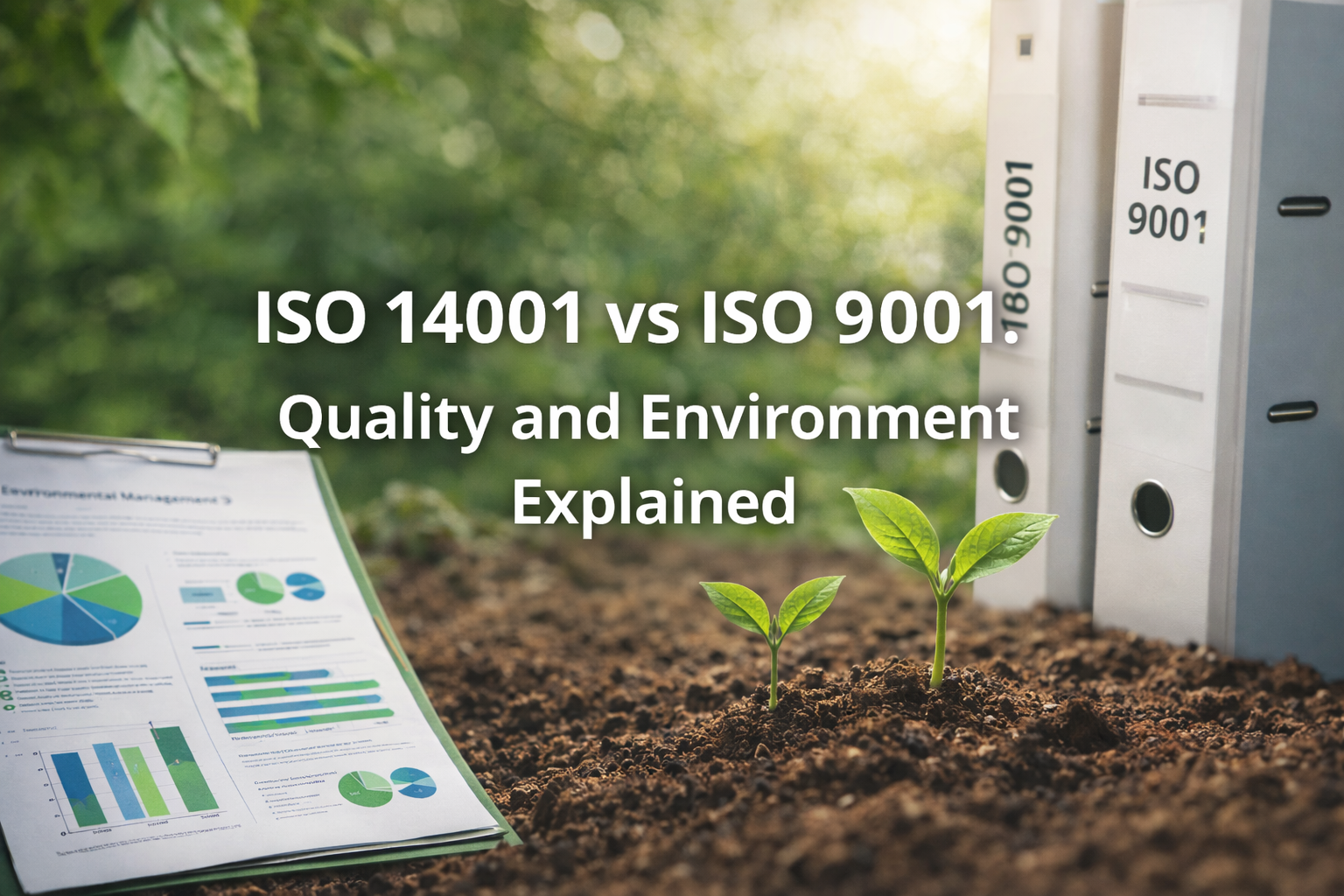
Understand the difference between ISO 14001 and ISO 9001, how environmental and quality management systems work, and why organisations use both standards.
Many organisations hear about ISO standards when improving business processes, meeting regulations, or building trust with customers. Two of the most widely used standards are ISO 9001 and ISO 14001. While they are often mentioned together, they focus on different areas of management.
ISO 9001 is centred on quality management. It helps organisations deliver consistent products and services that meet customer expectations. ISO 14001 focuses on environmental management and helps organisations understand and control their environmental impact.
Understanding how these standards differ, and how they can work together, helps organisations make better decisions about management systems and long-term improvement.
ISO 9001 is the international standard for quality management systems. It helps organisations create structured processes to ensure products and services meet customer and regulatory expectations.
The main purpose of ISO 9001 is to improve consistency, reliability, and customer satisfaction.
Key areas covered by ISO 9001 include:
• Process control and documented procedures
• Customer satisfaction and feedback
• Risk-based thinking in business processes
• Continuous improvement of products and services
• Leadership responsibility for quality
For example, a manufacturing company producing electrical components may use ISO 9001 to ensure each product meets the same quality standards every time. Clear procedures, inspections, and quality checks help reduce defects and improve reliability.
Quality management under ISO 9001 is not limited to manufacturing. Service organisations, logistics providers, technology companies, and public sector organisations also use it to maintain consistent service delivery.
In many organisations, ISO 9001 becomes the foundation of a structured management system.
ISO 14001 focuses on environmental management. It provides a framework for organisations to identify, manage, monitor, and improve environmental performance.
Rather than concentrating on product quality, ISO 14001 looks at how business activities affect the environment.
An ISO 14001 environmental management system helps organisations manage issues such as:
• Waste generation
• Energy use
• Resource consumption
• Emissions and pollution
• Environmental legal compliance
For example, a logistics company operating a large vehicle fleet may identify fuel consumption and emissions as key environmental impacts. By tracking fuel use and improving efficiency, the organisation can reduce environmental impact and operating costs.
Organisations using the environmental management standard also review their legal responsibilities. Environmental regulations often apply to areas such as waste disposal, water discharge, or air emissions. A structured environmental management system helps ensure these obligations are understood and monitored.
This structured approach is one of the reasons many organisations adopt ISO 14001 certification as part of broader sustainability and compliance strategies.
For organisations trying to understand the relationship between environmental management and legal compliance, this guide explains the connection in more detail:
https://reliablecert.uk/resources/how-iso-14001-helps-organisations-meet-environmental-laws
Although both standards are management system frameworks developed by the International Organization for Standardization, they address different organisational priorities.
ISO 9001 focuses on product and service quality.
ISO 14001 focuses on environmental performance.
Some of the main differences include:
Purpose
ISO 9001
Improving product and service quality
ISO 14001
Managing environmental impact and sustainability
Primary focus
ISO 9001
Customer satisfaction and process efficiency
ISO 14001
Environmental risks, compliance, and resource management
Key outcomes
ISO 9001
Consistent quality and improved customer confidence
ISO 14001
Reduced environmental impact and stronger environmental responsibility
Despite these differences, the standards share a common structure. Both follow the High-Level Structure used across modern ISO management standards. This means they include similar sections such as leadership, planning, support, operation, performance evaluation, and improvement.
Because of this shared structure, organisations often implement both systems together.
Many organisations integrate quality and environmental management systems. Instead of operating separate systems, they combine the requirements into one integrated management system.
This approach can bring several advantages.
First, many processes overlap. For example, internal audits, risk assessments, and management reviews can be carried out for both standards at the same time.
Second, organisations benefit from consistent documentation and responsibilities across departments.
A manufacturing organisation may combine both standards in the following way:
Quality management focuses on product reliability, inspection processes, and customer requirements.
Environmental management focuses on energy efficiency, waste reduction, and responsible material use.
Together, the two systems help the organisation produce reliable products while reducing environmental impact.
This integration approach is also common when organisations implement additional standards such as:
ISO 45001 for occupational health and safety
ISO 27001 for information security management
ISO 50001 for energy management
ISO 22000 for food safety management
ISO 22301 for business continuity management
Each standard focuses on a different operational area, but the shared structure allows them to work together within a single management framework.
The choice between ISO 9001 and ISO 14001 often depends on the organisation’s priorities.
Organisations focused on improving product or service quality often start with ISO 9001.
Organisations facing environmental regulations, sustainability expectations, or environmental risks often implement ISO 14001.
However, many organisations adopt both standards because they address different but complementary objectives.
For example:
A construction company may use ISO 9001 to manage project quality and customer satisfaction, while using ISO 14001 to control environmental impacts such as waste, noise, and site pollution.
A food manufacturer may use ISO 9001 for process control and combine it with ISO 22000 for food safety and ISO 14001 for environmental management.
An energy-intensive manufacturer may integrate ISO 14001 with ISO 50001 to better control environmental and energy performance.
These examples show how management system standards can support operational improvement across multiple areas.
Understanding the difference between ISO 9001 and ISO 14001 helps organisations choose the right management system framework.
Quality management systems improve reliability, customer confidence, and process control.
Environmental management systems help organisations understand environmental risks, meet legal obligations, and reduce environmental impact.
For organisations working toward responsible and sustainable operations, environmental management has become increasingly important. A structured environmental management system provides a practical framework for identifying risks and improving environmental performance over time.
ISO 9001 and ISO 14001 are two of the most widely used management standards worldwide. Although they address different areas, both aim to improve organisational performance through structured processes and continual improvement.
ISO 9001 focuses on quality and customer satisfaction.
ISO 14001 focuses on environmental responsibility and environmental impact.
Because both standards share a common structure, many organisations implement them together as part of an integrated management system.
Understanding how each standard works helps organisations make informed decisions about management systems and long-term operational improvement.
What is the main difference between ISO 9001 and ISO 14001?
ISO 9001 focuses on quality management and improving customer satisfaction. ISO 14001 focuses on environmental management and reducing environmental impact.
Can an organisation implement ISO 9001 and ISO 14001 together?
Yes. Many organisations combine the two standards into an integrated management system because they share a similar structure and management approach.
Is ISO 14001 only relevant for manufacturing companies?
No. ISO 14001 can apply to any organisation whose activities affect the environment. This includes offices, construction companies, logistics providers, and service organisations.
Do ISO 9001 and ISO 14001 follow the same structure?
Yes. Both standards use the ISO High-Level Structure, which includes sections such as leadership, planning, support, operation, evaluation, and improvement.
Why do organisations implement environmental management systems?
Environmental management systems help organisations understand environmental risks, meet legal requirements, reduce waste and emissions, and improve environmental performance over time
 1
1
Typically replies within 30 minutes