02031613720
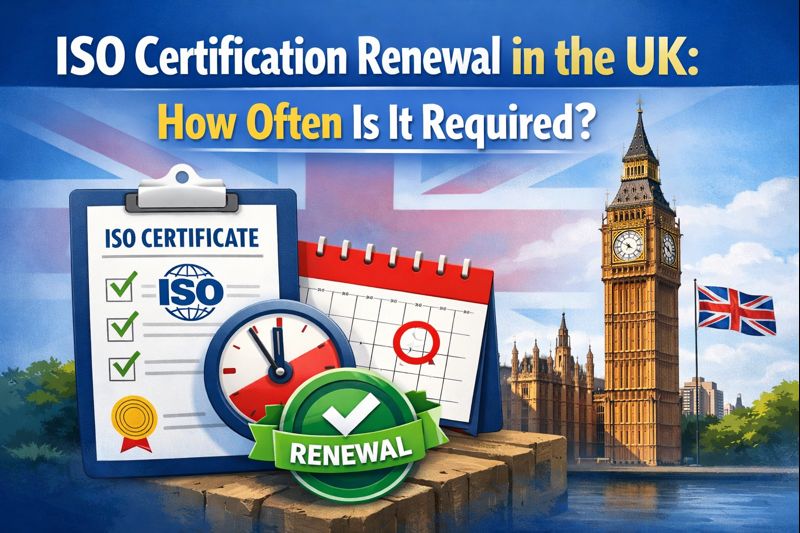
Learn how often ISO certifications must be renewed in the UK, including surveillance audits, recertification timelines, and compliance considerations.
ISO certification is not a one-time achievement. For UK organisations, certification must be maintained and renewed through a defined audit cycle to remain valid and credible. Understanding how often ISO certifications require renewal helps businesses avoid lapses that could affect contracts, compliance obligations, and commercial credibility.
This guide explains the requirements for ISO certification renewal in the UK, including audit frequency, recertification timelines, and the consequences of failing to maintain certification.
In the UK, ISO certifications are issued on a three-year certification cycle, subject to successful completion of ongoing audits.
ISO standards are developed by the International Organization for Standardization and are designed around the principle of continual improvement. As a result, certification must be reviewed periodically to confirm that management systems remain effective and compliant.
A valid ISO certificate therefore, depends on:
The certification process begins with an initial audit, typically conducted in two stages:
Once these stages are successfully completed, the organisation is issued an ISO certificate that remains valid for three years, subject to ongoing surveillance.
During the second and third years of certification, organisations must undergo annual surveillance audits.
These audits are designed to:
Surveillance audits are less extensive than the initial certification audit but are mandatory to maintain certification status.
Before the certificate expires, a recertification audit must be completed.
This audit:
Failure to complete the recertification audit before expiry may result in certification lapse.
A UK manufacturing company achieves ISO certification in April 2024.
Following a successful recertification audit, the organisation receives a renewed certificate valid until April 2030, provided annual surveillance audits continue.
The certification cycle is consistent across most ISO standards commonly used in the UK, including:
While audit focus and technical requirements differ by standard, the renewal structure remains the same.
In the UK, the credibility of ISO certification depends on accreditation.
The UK Accreditation Service (UKAS) is the only government-recognised body responsible for accrediting certification bodies.
UKAS accreditation ensures that:
For public sector tenders and regulated supply chains, UKAS-accredited certification is typically required.
Surveillance audits typically focus on selected areas of the management system rather than a full reassessment.
They usually include:
Preparation and system maintenance significantly reduce the risk of nonconformities.
Nonconformities identified during surveillance or recertification audits do not usually result in immediate loss of certification.
Instead:
However, unresolved or repeated nonconformities may lead to suspension or withdrawal of certification.
Failure to complete surveillance or recertification audits on time can have serious consequences.
These may include:
For businesses operating in regulated or competitive environments, allowing certification to lapse can be disruptive and costly.
ISO certification does not replace statutory obligations but supports structured compliance.
For example:
Regular audits help organisations demonstrate due diligence and systematic control.
ISO renewal is not a legal requirement for SMEs, but it is often a commercial necessity.
Many UK SMEs maintain certification to:
Once certification is established, maintaining it is usually more efficient than allowing it to lapse and re-certifying later.
Organisations that manage renewal successfully typically:
Embedding ISO requirements into everyday operations reduces renewal effort and audit risk.
Understanding renewal requirements is a critical part of ISO Certification UK services. Certification is not only about achieving initial approval but also about maintaining ongoing compliance and credibility.
This guidance supports related topics such as audit preparation, certification timelines, and accreditation requirements, helping organisations manage ISO certification with confidence.
ISO certifications in the UK operate on a three-year cycle, supported by annual surveillance audits and a recertification audit at the end of each cycle.
Renewal is an essential component of ISO certification, ensuring that management systems remain effective, compliant, and aligned with organisational objectives. Businesses that understand and plan for renewal requirements reduce risk, protect commercial opportunities, and maintain trust with clients and stakeholders.
 1
1
Typically replies within 30 minutes