02031613720
Understand how long ISO 9001 certification usually takes, what affects the timeline, and how organisations move from preparation to certification.
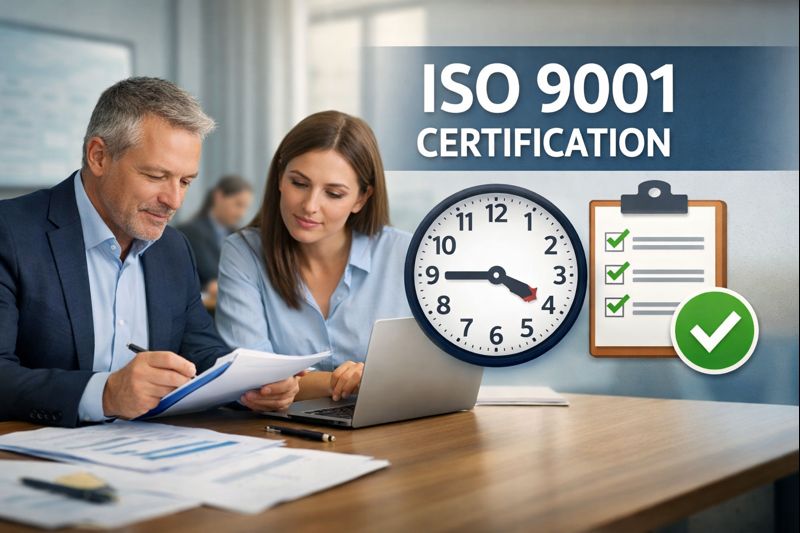
ISO certification is often discussed in terms of benefits, but organisations usually want to understand the practical reality before committing time and effort. One of the most common questions asked at the beginning is how long ISO 9001 certification actually takes.
The answer is not fixed. The time required depends on how an organisation currently operates, how complex its activities are, and how prepared it is to formalise its processes. ISO 9001 is not designed to be rushed. It is meant to reflect how work is done in practice and how that work can be improved over time.
This guide explains the certification timeline in a clear and realistic way, helping organisations understand what happens at each stage and why the process takes the time it does.
ISO 9001 is an international standard for quality management systems. Its main purpose is to help organisations consistently meet customer requirements while improving internal performance. It focuses on leadership responsibility, process control, risk awareness, and continual improvement.
ISO 9001 does not prescribe how a business should operate. Instead, it asks organisations to clearly define their own processes, follow them consistently, and regularly review whether those processes are effective. Because of this flexible approach, ISO 9001 can be applied across many industries, from manufacturing and construction to professional services and technology.
In most cases, ISO 9001 certification takes between three and six months from the point an organisation begins preparing seriously. This timeframe allows enough time to understand the standard, align existing practices, and demonstrate that the quality management system is actually working.
Smaller organisations with simple structures may complete certification more quickly, sometimes in as little as two to three months. Larger or more complex organisations may take longer, especially if they operate across multiple locations or have highly regulated activities.
The key point is that the timeline reflects readiness rather than speed. ISO 9001 certification is based on evidence, not intention.
No two organisations follow the same path to certification. Several factors influence how long the process takes, and understanding these helps set realistic expectations.
One major factor is organisational size and complexity. An organisation with a small team and a limited number of processes can define and implement a quality management system more quickly than one with many departments, varied services, or multiple operational sites.
Another important factor is how processes are currently managed. Organisations that already have structured procedures, defined responsibilities, and performance monitoring often progress faster. Where processes exist mainly in people’s heads, more time is needed to document and stabilise them.
Leadership involvement also plays a significant role. When senior management actively supports the process, decisions are made more quickly, priorities are clear, and staff engagement improves. Without this support, progress can slow at every stage.
The first stage of the journey involves understanding what ISO 9001 requires and how it applies to the organisation. This phase often takes a few weeks and focuses on awareness rather than change.
During this time, organisations review their current way of working and compare it against the standard. Gaps are identified, not as failures, but as areas that need clarification or improvement. This step is essential because it shapes the scope and direction of the quality management system.
Rushing this stage often leads to confusion later. A clear understanding early on reduces rework and delays during audits.
Once the requirements are understood, the organisation begins developing or refining its quality management system. This stage usually takes the most time, often several weeks or longer.
Here, processes are clearly defined, responsibilities are assigned, and objectives are set. Documentation is created where it adds value, such as describing how key activities are controlled or how issues are identified and resolved. The emphasis is on clarity and consistency, not volume.
This phase requires careful thought because the system must reflect real operations. If the system does not match how work is actually done, it will not perform well during audits or daily use.
A quality management system cannot exist only on paper. ISO 9001 requires evidence that processes are being followed in practice.
Implementation involves using the defined processes in everyday work, recording outcomes, and addressing issues as they arise. This stage allows the organisation to test whether the system is practical and effective.
Time is needed here to build confidence and consistency. Auditors expect to see records over a reasonable period, showing that the system is stable rather than newly introduced.
Before an external audit takes place, organisations are required to review their own system. This includes internal audits and management review activities.
Internal audits help identify weaknesses or gaps while there is still time to address them. Management reviews ensure leadership understands how the system is performing and what improvements are needed.
This stage often reveals small issues that can be corrected easily. Addressing them before certification reduces the risk of delays later.
The external certification audit is usually carried out in two stages. The first stage focuses on reviewing documentation and confirming readiness. The second stage examines how the system works in practice.
During the audit, assessors review processes, speak with staff, and examine records. The goal is not to find fault, but to confirm that the organisation meets the requirements of ISO 9001.
If minor issues are identified, organisations are given time to correct them. Once these are addressed, certification can be granted.
ISO 9001 certification is valid for three years, but it is not a one-time event. Organisations must maintain their system, continue internal reviews, and demonstrate ongoing improvement.
Annual surveillance audits check that the system remains effective and aligned with the standard. These audits are usually shorter and focus on selected areas.
ISO 9001 is often the first standard organisations adopt because it applies broadly and supports overall management effectiveness. Other standards may require additional preparation time depending on their focus.
For example, ISO 14001 addresses environmental impacts, while ISO 45001 focuses on workplace safety. Information security requirements are covered by ISO 27001, which involves more technical controls.
Each standard has its own scope and complexity, but ISO 9001 often provides a strong foundation for integrating others later.
The time required for ISO 9001 certification reflects the purpose of the standard. It is designed to improve how organisations operate, not to provide a quick label.
Taking the time to properly understand, implement, and review the system leads to more meaningful outcomes. Organisations that rush the process often struggle during audits or fail to gain real value from certification.
ISO 9001 certification typically takes several months because it involves real change, not just formal approval. The process allows organisations to understand their operations better, reduce risk, and improve consistency.
When approached with patience and clarity, ISO 9001 becomes a practical management tool rather than an administrative burden. The timeline is simply part of building a system that works in the long term.
Most organisations complete ISO 9001 certification within three to six months. The exact time depends on size, structure, and how well processes are already defined.
Yes, in some cases. Organisations with clear processes and strong management involvement may complete certification more quickly, but rushing often leads to audit delays.
Yes. The timeline includes preparation, internal review, and the external certification audit, which is usually carried out in two stages.
ISO 9001 is often faster than standards like ISO 27001 or ISO 14001, as it focuses on general quality management rather than technical controls.
If minor issues are found, organisations are normally given time to correct them before certification is confirmed
 1
1
Typically replies within 30 minutes