02031613720
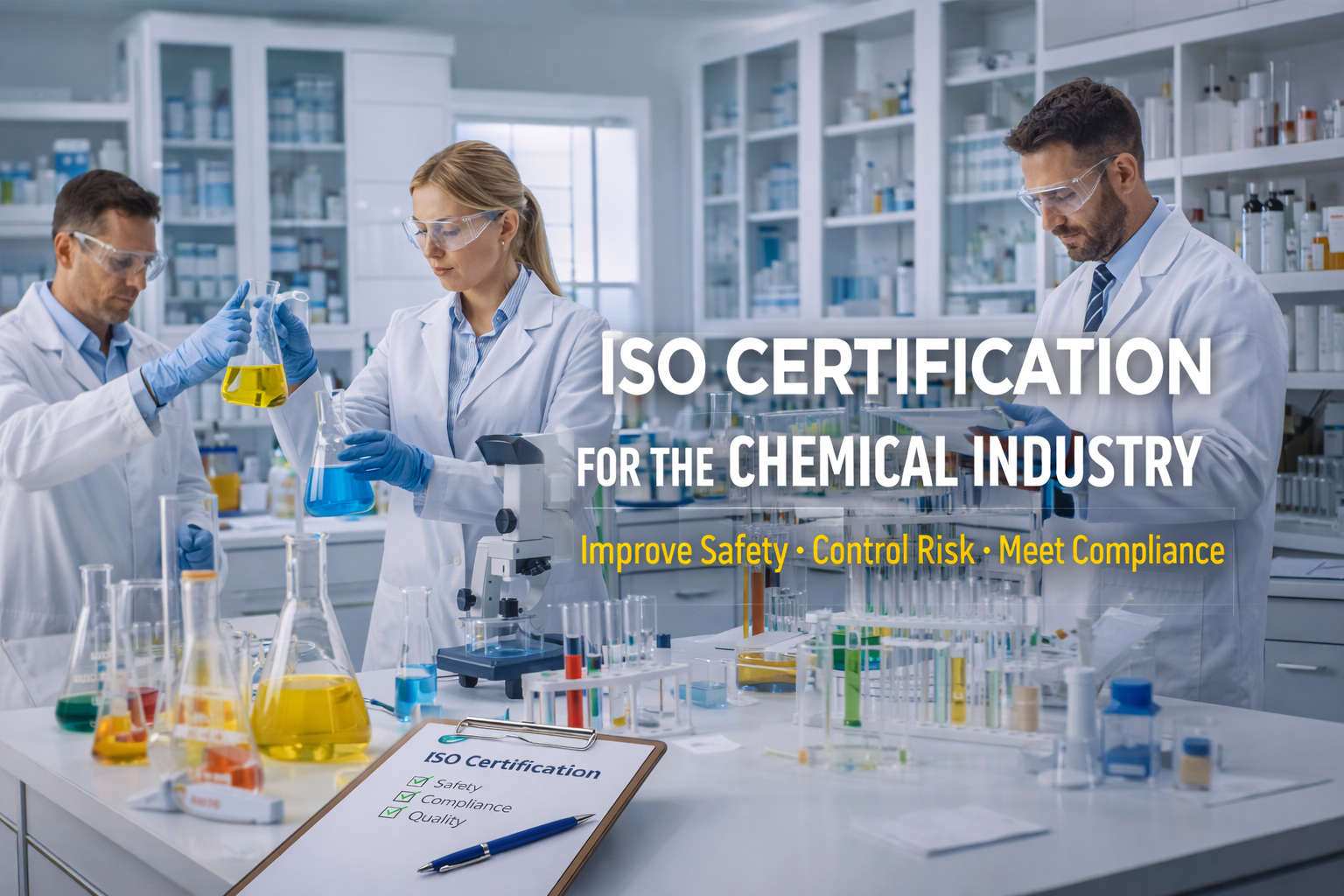
Chemical businesses must manage safety, environmental impacts, and applicable compliance requirements. ISO management system standards provide a structured framework for managing these responsibilities, while independent certification assesses whether the organisation’s management system conforms to the applicable standard. Whether you are a manufacturer, laboratory, or supplier, ISO standards can support structured and consistent operations.
 Chemical
Chemical
Chemical
By submitting your information, you are agreeing to our Terms & Conditions and our Privacy Policy.
Improve Safety, Environmental Control and Compliance
The chemical industry plays a vital role across manufacturing, healthcare and industrial sectors. However, working with chemicals brings serious risks and responsibilities.
Businesses must ensure:
ISO management system standards provide a structured framework for managing these responsibilities, while independent certification assesses whether the management system conforms to the applicable standard requirements.
Chemical organisations deal with complex risks every day. Without effective management controls, these risks can contribute to serious incidents.
A chemical company storing industrial substances may face penalties if safety procedures are unclear or poorly documented. Management systems based on applicable ISO standards can support clear controls, responsibilities and accountability.
Chemical organisations must determine and meet applicable legal, regulatory and safety requirements.
Examples of relevant UK requirements and guidance may include:
ISO management system standards can support structured processes for addressing applicable requirements. Certification independently assesses the management system against the requirements of the relevant ISO standard and does not replace the organisation’s legal or regulatory responsibilities.
Different ISO standards address different areas of chemical operations.
Supports the management of environmental aspects, waste, emissions and other environmental impacts.
Focuses on occupational health and safety management, including risks associated with hazardous substances and workplace activities.
Focuses on quality management, process consistency and customer requirements.
Effective operation of ISO management systems can support more consistent and controlled chemical operations.
Many organisations request recognised management system certification as part of customer, supplier or contractual requirements.
ISO certification may be suitable for:
If your business handles chemicals at any stage, a well-maintained management system can support risk control and operational performance, while certification provides independent assessment against the applicable standard.
Chemical Manufacturers
ISO 14001 may be relevant where environmental aspects, emissions and waste form part of the organisation’s environmental management system.
Laboratories
ISO 45001 may be relevant where occupational health and safety risks include chemical exposure or laboratory activities.
Chemical Distributors
ISO 9001 may be relevant where process consistency, traceability and customer requirements are important.
Many businesses experience management system challenges due to issues such as:
These issues may result in nonconformities during certification audits or contribute to regulatory concerns.
Management systems based on applicable ISO standards can provide structured processes and controls for organisations to manage these issues.
Submit information about your organisation, requested standard and proposed certification scope. Reliable Certification reviews the application to determine the applicable certification arrangements.
Audit duration, audit team competence, sites and audit arrangements are determined based on the applicable certification requirements.
Where applicable, Stage 1 evaluates relevant management system information and readiness to proceed to Stage 2.
The audit team evaluates the operation and effectiveness of the management system against the applicable standard requirements.
Following completion of applicable audit activities, the audit information is independently reviewed and an authorised certification decision is made.
Certified organisations are subject to planned surveillance and recertification activities throughout the certification cycle.
Certification cost and timeframe depend on factors including the applicable standard, certification scope, organisation size, complexity, number of sites and required audit duration.
A formal quotation and applicable certification arrangements are determined after application and contract review.
Reliable Certification provides independent and professional management system certification.
The organisation remains responsible for its management system, processes, controls and corrective actions.
If your organisation requires independent management system certification, Reliable Certification can assess your management system against the applicable ISO standard and defined certification scope.
Contact our certification team to submit your requirements and request a quotation.
What is the most important ISO standard for chemical companies?
ISO 14001 and ISO 45001 are commonly relevant to chemical-sector organisations because of environmental and occupational health and safety considerations. The applicable standard depends on the organisation’s activities and certification requirements.
Is ISO certification required for chemical businesses?
It is not universally mandatory, but certification may be required by clients, contracts, procurement frameworks or other interested parties.
How long does certification take?
The certification timeframe depends on factors such as the applicable standard, organisation size, complexity, certification scope, number of sites and required audit duration.
Does ISO certification help with safety compliance?
Certification provides an independent assessment of the organisation’s management system against the applicable ISO standard. It does not replace the organisation’s responsibility to meet applicable legal and regulatory requirements.
Can small chemical businesses get certified?
Yes. Management system certification is available to organisations of different sizes, subject to applicable certification requirements.
Certification arrangements are determined following application and contract review and depend on the applicable standard, scope, organisation size, complexity and other relevant factors.
 1
1
Typically replies within 30 minutes