02031613720
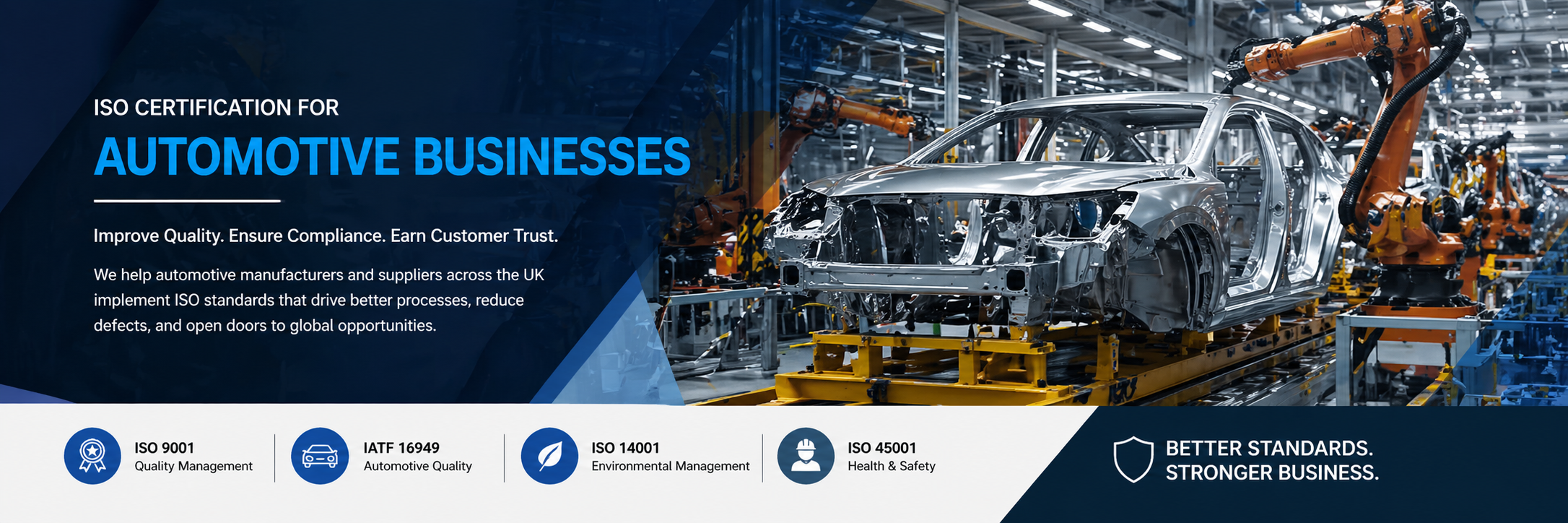
The automotive industry in the UK requires strict quality, safety, and compliance standards to operate efficiently. ISO certification for the automotive industry helps manufacturers and suppliers improve processes, meet global requirements, and build trust with OEMs. Standards such as ISO 9001 and IATF 16949 are essential for ensuring product quality, reducing defects, and gaining access to international supply chains.
 Automotive
Automotive
Automotive
By submitting your information, you are agreeing to our Terms & Conditions and our Privacy Policy.
Independent ISO Certification for Automotive Manufacturers and Suppliers
Reliable Certification provides independent management system certification for automotive businesses across the UK. Whether you are a manufacturer, parts supplier, engineering company or service provider, certification can provide independent evidence that your management system has been assessed against recognised requirements.
Demonstrate Quality, Safety and Effective Management Through Independent Certification
The automotive sector operates under strict quality, safety and customer requirements. Whether you are a manufacturer, supplier or engineering company, maintaining effective management controls is important for operating consistently in this highly demanding sector.
ISO management system certification provides independent assessment of an organisation’s management system against recognised requirements. Depending on the requested certification scope, relevant areas may include quality management, environmental management, occupational health and safety, information security and business continuity.
At Reliable Certification, we independently assess automotive organisations against the applicable management system standard and defined certification scope.
The automotive sector in the UK includes businesses that manufacture vehicles, produce components, provide engineering services and support automotive supply chains. This can include vehicle manufacturers, parts suppliers, engineering companies and logistics providers.
In real terms, many businesses in this industry are:
To operate successfully, companies must:
Without effective management controls, businesses may experience rejected parts, audit nonconformities, customer concerns or difficulty meeting supplier requirements.
The applicable ISO standard depends on the organisation’s activities, certification scope and customer or contractual requirements.
ISO 9001 specifies requirements for a quality management system. For automotive businesses, it may be relevant to areas such as production control, customer requirements, supplier management, monitoring, corrective action and continual improvement.
ISO 14001 specifies requirements for an environmental management system. Relevant aspects for automotive organisations may include waste, emissions, resource use, chemicals, energy use and other environmental impacts associated with operations.
ISO 45001 specifies requirements for an occupational health and safety management system. It may be relevant where risks arise from machinery, tools, manual handling, production activities, vehicle movement or contractor work.
ISO/IEC 27001 specifies requirements for an Information Security Management System. It may be relevant where automotive organisations manage customer information, design data, production information, supplier data or other sensitive information.
ISO 22301 specifies requirements for a Business Continuity Management System and may be relevant where organisations need to maintain critical activities during disruption, system failure, supplier interruption or other significant events.
ISO certification provides independent evidence that an organisation’s management system has been assessed against recognised requirements. It may also support customer, supplier, tender or contractual requirements.
Automotive businesses face operational and management system challenges linked to manufacturing, suppliers, quality requirements and customer expectations:
Management systems based on applicable ISO standards can provide a structured framework for organisations to manage these issues, while certification independently assesses conformity against the applicable standard.
Reliable Certification follows an independent certification process based on the applicable standard, requested certification scope and certification requirements.
The organisation submits relevant information including the requested standard, proposed certification scope, number of employees, sites and activities. Reliable Certification reviews the application to determine the applicable certification arrangements.
Audit duration, audit team competence, locations and audit arrangements are determined according to the applicable certification requirements.
Where applicable, Stage 1 evaluates relevant management system information and readiness to proceed to Stage 2. Any areas of concern are formally communicated to the organisation.
The audit team evaluates the operation and effectiveness of the management system against the applicable standard requirements. Any identified nonconformities are formally reported, and the organisation remains responsible for correction and corrective action.
Following completion of applicable audit activities, relevant audit information is independently reviewed and an authorised certification decision is made by personnel not involved in conducting the audit.
The cost of ISO certification for automotive businesses depends on several factors. Each organisation has different activities, scope, size and complexity, so certification costs are determined following application and contract review.
Key factors that influence the cost include:
A formal quotation is provided after the required organisation and certification information has been reviewed.
Reliable Certification provides clear certification quotations based on the applicable certification requirements and audit arrangements.
The time required for certification depends on factors such as the applicable standard, organisation size, certification scope, complexity, number of sites, audit duration and certification outcome.
The certification process generally includes application and contract review, audit planning, Stage 1 where applicable, Stage 2, review of audit information and an independent certification decision.
Reliable Certification does not promise a fixed certification timeframe. The applicable arrangements are determined following review of the organisation’s information and certification requirements.
Choosing an independent certification body is an important part of the certification process.
Our audit teams are assigned based on applicable competence requirements for the requested certification scope.
Certification activities are planned according to the applicable standard, scope, organisation size, complexity and audit requirements.
We provide clear information about the certification process, audit arrangements, findings and certification cycle.
Certification audits are based on objective evidence and conformity with the applicable management system standard.
Certified organisations are subject to planned surveillance and recertification activities throughout the certification cycle.
ISO certification may be relevant to different types of organisations working in the automotive sector and supply chain.
Vehicle manufacturers may seek certification where independent assessment of quality, environmental, occupational health and safety, information security or business continuity management systems is required.
Parts and component suppliers may seek certification where customers, contracts or supplier approval processes require recognised management system certification.
Engineering and design organisations may seek certification against applicable management system standards based on their activities, customer requirements and certification scope.
Assembly and production organisations may seek certification where structured management system controls and independent assessment are required.
Logistics and supply-chain organisations may seek management system certification based on their activities and applicable customer or contractual requirements.
Automotive maintenance, repair and service providers may seek certification where recognised management system certification is relevant to their services or customer requirements.
Automotive suppliers may seek ISO certification to provide independent evidence that their management systems have been assessed against recognised requirements.
If your organisation requires independent management system certification for quality, environmental management, occupational health and safety, information security or business continuity, Reliable Certification can assess your management system against the applicable standard and certification scope.
Reliable Certification provides independent certification audits, formal reporting of findings, independent certification review and decision, surveillance, recertification and certificate verification.
Contact our certification team to submit your requirements and request a certification quotation.
Depending on the organisation’s activities and certification requirements, relevant standards may include ISO 9001, ISO 14001, ISO 45001, ISO/IEC 27001 and ISO 22301.
ISO management system certification is not universally mandatory. However, it may be required by customers, contracts, procurement frameworks or other interested parties.
The certification timeframe depends on factors including the applicable standard, organisation size, certification scope, complexity, number of sites, required audit duration and certification outcome.
Certification cost depends on factors such as organisation size, scope, complexity, number of sites and required audit duration. A quotation is provided following application and contract review.
Yes. Management system certification is available to organisations of different sizes, subject to applicable certification requirements.
Reliable Certification conducts independent management system certification activities including application and contract review, audit planning, Stage 1 and Stage 2 audits where applicable, formal reporting of findings, independent certification review and decision, surveillance and recertification.
Certification arrangements are determined following application and contract review and depend on the applicable standard, scope, organisation size, complexity and other relevant factors.
 1
1
Typically replies within 30 minutes